
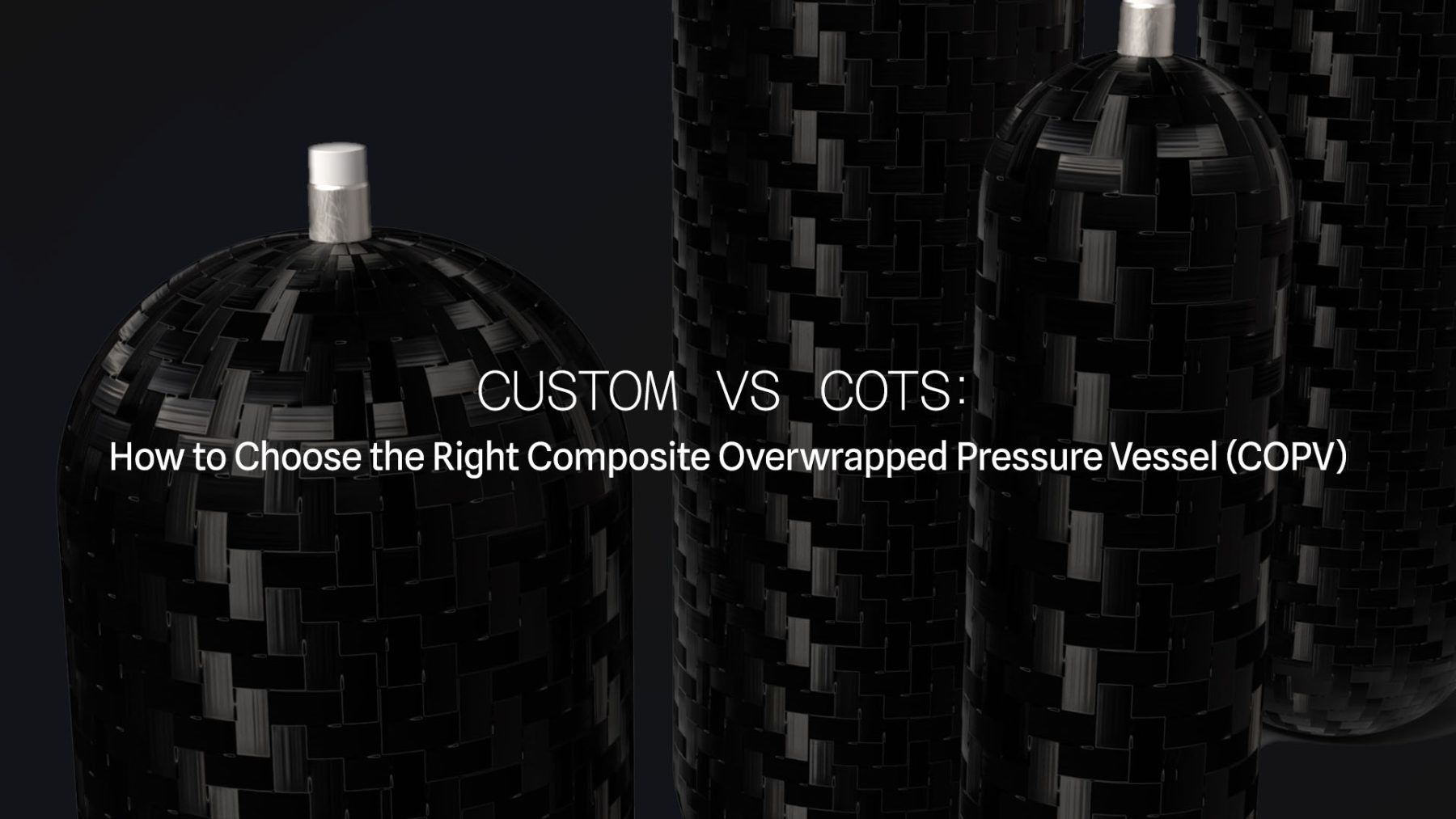
Key Insight: As satellite design cycles accelerate due to the ongoing boom, aerospace engineers face a critical decision when it comes to propulsion architecture: specify a Commercial Off-The-Shelf (COTS) Composite Overwrapped Pressure Vessel (COPV) for rapid integration, or invest in a custom-engineered tank to squeeze every possible gram of mass out of the payload. Choosing the right option means balancing budget while optimising the configuration of the satellite build.
The Mass and Volume Bottleneck
The commercial space sector is currently defined by two opposing forces: the drive to optimise mass and volume in satellite architecture and the need to maximise payload capacity. One of the keys to solving both is the storage of high-pressure propellants and pressurant gases.
In essence, every gram used for structural mass is a gram stolen from the primary payload. To help solve this issue, modern launch vehicles and satellite propulsion systems have universally adopted Carbon Composite Overwrapped Pressure Vessels (COPVs). By reinforcing a high-performance, thin-walled metal liner with a precision-wound carbon fibre composite shell, COPVs deliver exceptional stiffness-to-weight ratios that legacy metal tanks simply cannot match.
However, selecting a COPV comes with its own set of questions. Procurement teams and propulsion engineers must balance a mix of mission requirements, orbital regimes and budget constraints. Ultimately, the decision comes down to choosing Commercial Off-The-Shelf (COTS) or opting for custom-engineered solutions.
The Case for COTS COPVs
In the rapidly expanding Low Earth Orbit (LEO) market, particularly for constellations of SmallSats and CubeSats, speed to orbit is the primary measure of commercial success. In these scenarios, Commercial Off-The-Shelf (COTS) COPVs offer significant advantages.
1. Accelerated Lead Times and Rapid Iteration: Standardised, off-the-shelf tanks remove months from the development cycle as the engineering, design qualification, and testing have already been completed, meaning COTS cylinders can be quickly integrated. This allows agile space companies to speed up the design and launch of their satellite.
2. Proven Flight Heritage (TRL 9): Space is the most unforgiving of environments, and investors are notoriously risk-averse. A primary advantage of selecting a high-quality COTS tank is immediate access to Technology Readiness Level 9 (TRL 9) hardware. Tanks that have proven flight heritage across multiple orbital regimes drastically reduce the risk profile of a mission, eliminating the uncertainties associated with untested bespoke designs.
3. Economic Scalability: For mega-constellations requiring hundreds of identical propulsion units, COTS COPVs offer the benefits of economies of scale. Purchasing standard sizes from an established, high-volume aerospace manufacturing facility ensures unit cost reductions and reliable supply chain logistics.
The Case for Custom COPVs
While COTS solutions dominate the fast-paced LEO economy, they’re not a universal solution. High-value, long-duration missions – such as those operating in Medium Earth Orbit (MEO), Geosynchronous Equatorial Orbit (GEO), or deep space – present unique constraints that demand a bespoke engineering approach.
1. Maximising the Volumetric Envelope: Custom COPVs allow engineers to dictate the exact dimensions, port configurations, and mounting interfaces, ensuring the tank fits seamlessly into the available volumetric envelope without forcing compromises in the rest of the spacecraft’s architecture.
2. Bespoke Performance Parameters: Deep space exploration and prolonged orbital logistics demand extreme performance metrics. A custom COPV can be engineered to handle specific, non-standard operating pressures or to conform to unique spacecraft geometries.
Furthermore, advanced, radiation-hardened resin systems combat the severe degradation and vacuum outgassing experienced in high-radiation environments such as higher Earth orbits, while pre-impregnated (pre-preg) carbon filaments deliver critical mass and weight savings.
3. Ultimate Mass Reduction: When a mission pushes the absolute limits of the Tsiolkovsky rocket equation, every fraction of a gram matters. A custom tank can be overwrapped with bespoke filament winding patterns, placing additional carbon fibre along load paths where stress concentrations are highest and eliminating redundant material elsewhere. This tailored, fibre-level optimisation yields an ultra-lightweight tank that maximises the strength-to-weight ratio and minimises dry structural mass.
How To Make The Right Decision?
Choosing between a COTS and a Custom COPV is not a question of which is universally “better,” but rather which aligns with the mission objective.
- Specify a COTS COPV when: The mission is cost-sensitive, the development schedule is highly compressed, the spacecraft architecture is flexible enough to accommodate standard geometries, and proven TRL 9 flight heritage is required immediately.
- Specify a Custom COPV when: Operating in harsh, multi-orbit environments, the volumetric envelope is strictly limited, non-standard pressures or thermal tolerances are required, or the payload demands the absolute maximum reduction in structural mass.
Whether your mission demands the rapid integration of off-the-shelf hardware or the precision of atomic-level material engineering, the structural integrity of your propulsion system remains paramount.